
One of the most popular statements today is:
“Know your worth.”
It sounds inspiring, and to a large extent, it is true. But there is another truth that is often ignored:
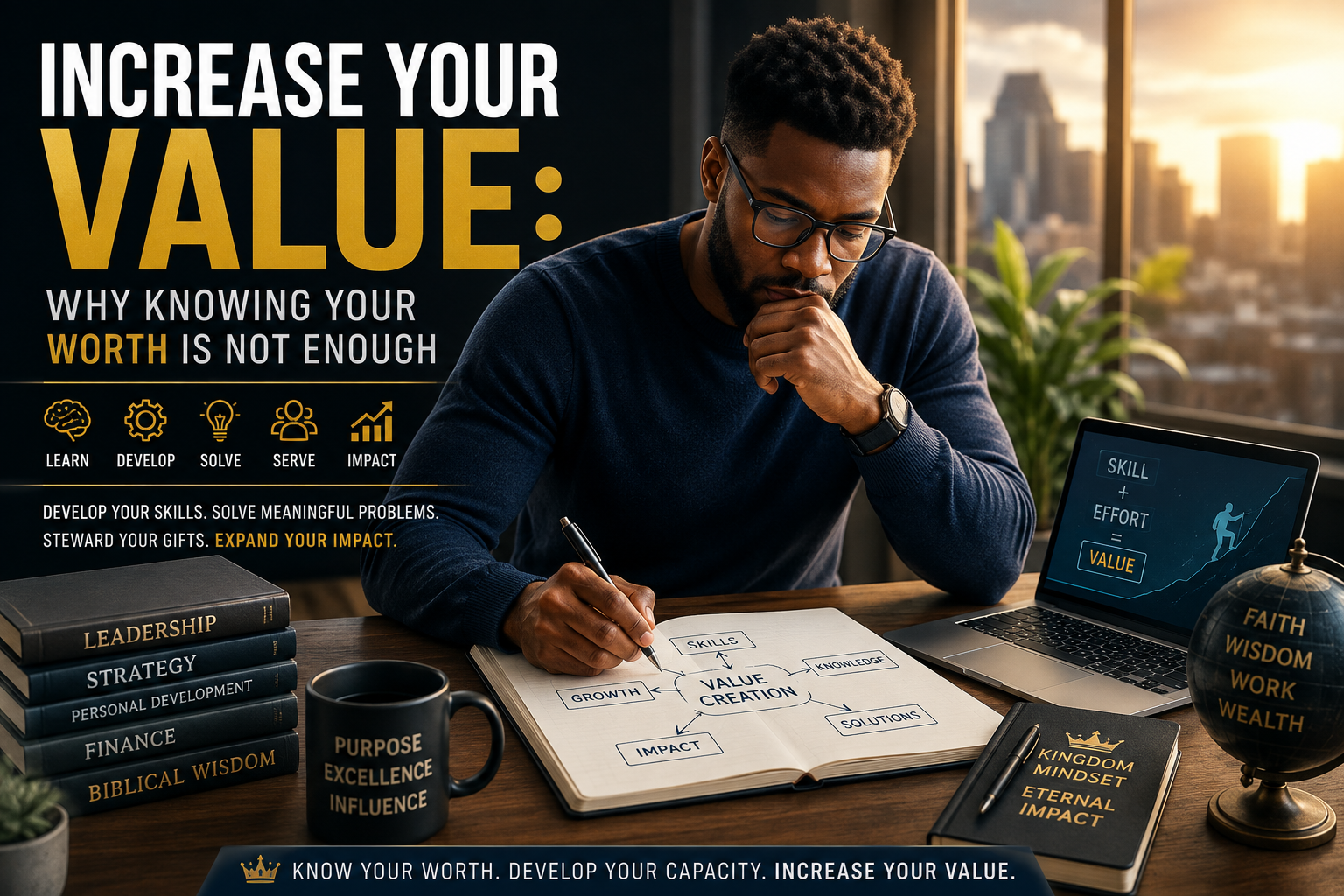
Knowing your worth is not enough. You must continually increase your capacity to create value.
There is an important distinction here.
Your worth is intrinsic. Your value delivered to others can grow.
You do not become more valuable as a human being because you acquire more money, skills, education or influence. Your worth before God is not determined by your income, position or productivity.
But your capacity, competence, usefulness and ability to create value can, and should grow.
Many people want greater opportunities, greater income and greater influence without increasing their capacity to carry them.
Confidence without competence eventually leads to disappointment.
The Kingdom of God calls us to faithful stewardship, while the marketplace generally rewards useful outcomes. Both should challenge us to ask a serious question:
What am I doing with what God has placed in me?
Your Worth Is Given. Your Capacity Must Be Developed.
God has deposited something valuable in every person.
You carry abilities.
You carry experiences.
You carry ideas.
You carry relationships.
You carry opportunities.
You carry a measure of knowledge and wisdom that can potentially become a blessing to other people.
But potential is not the same as developed capacity.
A seed contains a tree, but a seed is not yet a forest.
In the same way, possessing a gift does not automatically mean that you have developed the capacity to use that gift at a high level.
This is one of the lessons in the Lord Jesus’ Parable of the Talents in Matthew 25:14–30.
The servants were entrusted with different amounts. The master expected them to steward what they had received.
The tragedy of the servant who received one talent was not that he had less than the others, itt was that he did nothing with what he had been given.
The question is therefore not merely:
“What do I have?”
The better question is:
“What am I becoming because of what I have?”
The Marketplace Rewards Value Creation
The marketplace does not operate primarily on wishes. Businesses survive by solving problems.
Professionals advance by producing results.
Entrepreneurs create wealth by solving problems at scale.
Customers spend money when they perceive that what they are receiving is worth more to them than what they are giving up.
This is why two people can work in the same industry and produce dramatically different economic outcomes.
They may have the same number of hours in a day, but their:
- skills may differ,
- experience may differ,
- networks may differ,
- problem-solving capacity may differ,
- communication ability may differ,
- judgment may differ,
- reputation may differ,
- and results may differ.
Therefore, instead of merely asking:
“How much am I worth?”
Ask:
“What valuable problems can I solve?”
That question moves you from self-esteem to stewardship.
Become a Person of Solutions
The world rarely rewards good intentions alone.
It rewards solutions.
Consider Joseph.
He did not merely interpret Pharaoh’s dream. He translated revelation into an economic strategy that prepared Egypt for a national crisis.
Daniel did not merely possess spiritual insight. He demonstrated extraordinary wisdom and understanding in matters that baffled others.
Nehemiah did not merely complain about Jerusalem’s broken walls. He organized people, mobilized resources and rebuilt what had been destroyed.
Paul did not merely possess theological knowledge. He communicated the gospel, planted churches, trained leaders and strengthened believers across nations.
Their influence was connected to what they could do with what they had received.
This is a powerful principle for anyone seeking greater influence:
Become increasingly capable of solving increasingly important problems.
Do not merely become more informed. Become more useful.
Do not merely accumulate knowledge. Convert knowledge into solutions.
Do not merely collect certificates. Develop competence.
Ask Yourself Better Questions
If you want to increase your capacity and value, begin with honest questions.
1. What problems can I solve?
Not theoretical problems. Real problems.
Who benefits from what you know?
What difficulty can you remove?
What inefficiency can you eliminate?
What result can you help someone achieve?
2. What can I do exceptionally well?
There is a difference between being familiar with something and becoming excellent at it.
Identify your strengths and deliberately develop them.
3. What am I learning?
Your current knowledge may have produced your current results.
If you want different results, you may need different knowledge.
4. What skills are becoming increasingly valuable?
The skills economy is changing rapidly. The World Economic Forum’s research shows that employers increasingly value a combination of technological capabilities and human skills such as analytical thinking, creative thinking, adaptability, leadership and lifelong learning.
Technology changes.
Industries change.
Markets change.
Consumer behaviour changes.
The person who refuses to learn eventually becomes dependent on knowledge acquired in a previous season.
5. Who can I learn from?
Mentorship compresses learning.
A wise mentor can help you avoid mistakes that might otherwise cost years.
6. What results am I producing?
Ultimately, potential must become performance.
What are you actually producing with what you know?
Invest in Your Personal Research and Development
One of the most powerful investments you can make is an investment in your own capacity.
Companies invest heavily in research and development because they understand that what works today may not be enough tomorrow.
The same principle increasingly applies to individuals. The World Economic Forum’s Future of Jobs Report 2025 identifies technological literacy, AI and big data, creative thinking, analytical thinking, resilience, leadership, and lifelong learning among the skills becoming increasingly important through 2030.
Your greatest investment may not be your next purchase, It may be your next season of learning.
Read.
Study.
Experiment.
Build.
Ask questions.
Find mentors.
Develop skills.
Study your field.
Study Scripture.
Observe the world.
Research problems.
Look for patterns.
Then turn what you learn into something useful.
Ask yourself:
- How much time do I spend reading?
- What new skill am I deliberately developing?
- Who is mentoring me?
- What books are stretching my thinking?
- What am I researching?
- What am I building?
- What am I practicing?
- Where am I becoming measurably better?
Growth is rarely accidental. It is usually intentional.
Communication Multiplies Value
You may possess extraordinary knowledge and still have limited influence if you cannot communicate what you know.
Communication is therefore not merely a soft skill, It is a value multiplier.
A brilliant idea locked inside your mind cannot help many people.
A solution you cannot explain is difficult to scale.
A message you cannot communicate clearly may never reach the people who need it.
The Lord Jesus communicated profound truths through stories, questions, illustrations and memorable statements.
Paul adapted his communication to different audiences while remaining faithful to the gospel.
Your ability to:
- speak,
- write,
- teach,
- present,
- negotiate,
- explain,
- persuade,
- listen,
- and communicate complex ideas simply can significantly increase the reach of your existing knowledge.
Learn to communicate what you know.
Diligence Makes Potential Visible
Solomon wrote:
“The precious possession of a diligent man is wealth.” — Proverbs 12:27, NKJV
Diligence develops gifts.
Discipline refines ability.
Consistency builds excellence.
Repetition creates mastery.
Many people want extraordinary results while maintaining ordinary habits.
But capacity is developed through repeated investment.
You become better by doing the work.
You become wiser by studying.
You become stronger by exercising your capacity.
You become more skilled through practice.
You become more trustworthy by consistently keeping your word.
Over time, these small improvements compound.
The goal is not to become valuable overnight, but to become more valuable every year.
Scroll Less. Build More.
We live in an age of unprecedented access to information.
You can spend hours watching other people teach, build, travel, earn, create and succeed.
But there is a danger:
You can become a permanent consumer of other people’s output.
Information is useful.
But information without application can become intellectual entertainment.
There comes a point when you must stop consuming and start creating.
Read the book. Then write.
Study the business. Then build.
Learn the technology. Then apply it.
Study Scripture. Then teach it.
Learn the skill. Then use it to serve someone.
Consumption has its place. Creation leaves a legacy.
Every hour invested in purposeful development can increase your capacity for years to come.
Increase Your Value Without Losing Your Identity
The rise of artificial intelligence makes continuous learning even more important. Recent World Economic Forum research highlights growing demand for AI literacy alongside distinctly human capabilities such as analytical thinking, creativity, resilience and collaboration.
There is one important caution.
Do not confuse increasing your value with trying to prove your worth.
You do not need to become successful before you become worthy.
You do not need a bigger salary before you have dignity.
You do not need a larger platform before God loves you.
You do not need more followers before your life matters.
Your worth does not fluctuate with your achievements.
But your stewardship can improve.
Your skills can improve.
Your character can improve.
Your capacity can improve.
Your influence can improve.
Your ability to serve others can improve.
That is the goal.
Not:
“I must become valuable so that I can matter.”
But:
“Because God has entrusted something to me, I will develop it faithfully so that I can serve more effectively.”
That is a completely different motivation.
The Higher Your Capacity, the Greater Your Potential Impact
As you develop yourself, you increase the number and complexity of problems you can solve.
As you solve better problems, you can create greater value.
As you create greater value, your opportunities can expand.
And as your opportunities expand, you can potentially serve more people.
This is why personal development should not be merely about making more money.
It should be about becoming a better steward of what God has entrusted to you.
More wisdom.
More competence.
More character.
More skill.
More discipline.
More creativity.
More capacity.
More service.
More impact.
Final Thoughts: Don’t Just Know Your Worth, Increase Your Capacity
Knowing your worth is important.
But knowing your worth should not become an excuse for refusing to grow.
You don’t need to prove your worth. You need to develop your capacity.
God has entrusted every person with something. The question is what you will do with it.
So ask yourself:
What am I doing to become more capable than I was yesterday?
What skill am I developing?
What problem am I learning to solve?
What knowledge am I converting into wisdom?
What am I building?
Who am I serving?
What am I becoming?
Less scrolling.
More learning.
More building.
More serving.
More creating.
More becoming.
Know your worth. But don’t stop there. Develop your capacity. Increase your value. Steward your gifts. Solve meaningful problems. And become a greater blessing to the Kingdom and to the world.
Frequently Asked Questions
What does it mean to increase your value?
Increasing your value means developing your knowledge, skills, character, competence and ability to solve meaningful problems and serve others effectively. It does not mean increasing your worth as a human being, which is intrinsic.
Is knowing your worth enough?
No. Knowing your worth can give you confidence and healthy self-respect, but it does not automatically increase your competence or capacity. Personal growth requires deliberate learning, practice, discipline and application.
How can I increase my personal value?
You can increase your capacity by developing valuable skills, acquiring useful knowledge, improving communication, solving increasingly important problems, building a trustworthy reputation and consistently producing results.
What does the Bible say about increasing your value?
The Bible emphasizes stewardship, diligence, wisdom and faithful use of what God has entrusted to us. Jesus’ Parable of the Talents in Matthew 25:14–30 is particularly relevant because the servants were expected to faithfully develop and use what they had received.
Does being more valuable mean being more important to God?
No. Your value to God is not determined by your income, achievements, social status or usefulness in the marketplace. Developing your abilities is a matter of stewardship and service, not earning God’s love or proving your worth.
Why is skill development important?
Skill development increases your capacity to perform, solve problems and serve others effectively. Proverbs 22:29 highlights the relationship between skillfulness and opportunity: a person who is diligent and skilled in their work can gain access to greater levels of responsibility.
How does communication increase your value?
Communication allows your knowledge and ideas to reach other people. The ability to write, teach, speak, negotiate and explain ideas clearly can multiply the impact of knowledge you already possess.
Why should I spend less time scrolling?
Constant consumption can consume time that could otherwise be invested in learning, practicing, creating and building. Social media itself is not necessarily the problem; the issue is allowing passive consumption to replace purposeful development.
What is the difference between potential and value?
Potential is what you could become or accomplish. Value is demonstrated through what you actually develop, produce, solve or contribute. Potential must be cultivated before it can produce significant results.
Can increasing my value increase my income?
It can, but there is no automatic guarantee. Income is influenced by many factors, including demand, scarcity, market conditions, positioning, negotiation, entrepreneurship and the ability to communicate value. Developing useful capabilities generally gives you a stronger foundation for creating economic opportunities.
Key Bible Passages
- Matthew 25:14–30 — The Parable of the Talents
- Proverbs 12:27 — Diligence
- Proverbs 22:29 — Skill and excellence
- Ecclesiastes 10:10 — Wisdom and skill
- Colossians 3:23–24 — Excellence in work
- Luke 16:10 — Faithfulness in little
- Daniel 1:17–20 — Wisdom, knowledge and excellence
- Genesis 41:38–41 — Joseph’s wisdom and leadership
Written by Pastor Chidi Prince Mbuko
Kingdom intelligence, leadership, wealth and personal development.
Published: September 3, 2026
Image: AI