
Why do some gifted people remain poor while others with seemingly ordinary abilities build businesses, transform industries, and leave generational legacies?
There are many ways to riches, but there is the biblical roadmap to prosperity.
Why do some nations possess vast reserves of oil, gold, fertile land, and natural resources, yet continue to struggle economically, while countries with few natural resources become global centres of innovation, technology, and prosperity?
These are not merely economic questions; they are stewardship questions.
And long before economists began studying wealth creation, the Bible had already revealed a timeless principle:
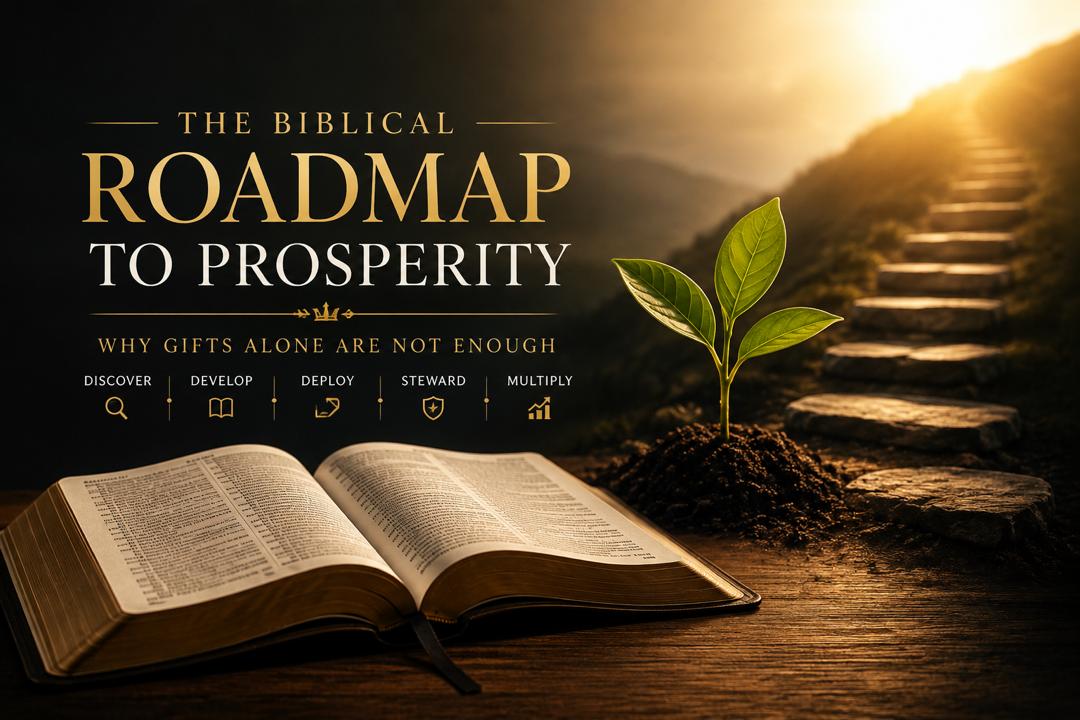
Prosperity is determined less by what you possess and more by how faithfully you discover, develop, steward, and multiply what God has entrusted to you.
This principle applies to individuals.
It applies to businesses.
It applies to churches.
It even applies to nations.
One of the greatest misconceptions about success and prosperity is that gifts alone produce success.
They do not.
The world is filled with gifted paupers and resource-rich nations living in economic squalor.
True kingdom prosperity is not determined by what you possess, but by the ruthless intentionality with which you refine, multiply, and steward what has been entrusted to you.
God gives gifts; but He expects stewardship.
Kingdom Intelligence: The Missing Ingredient
Many people pray for prosperity; but very few prepare for it.
Scripture consistently reveals that God does not merely bless possession.
He blesses faithful stewardship.
This is what we call Kingdom Intelligence; the God-given ability to recognise opportunities, develop capacity, solve meaningful problems, create value, and faithfully multiply what Heaven has placed in your hands.
Kingdom Intelligence transforms potential into productivity, turns gifts into influence, turns opportunities into impact, and turns ordinary resources into extraordinary outcomes.
The Parable of the Talents (Matthew 25:14–30) is not merely a story about money; it is God’s blueprint for stewardship.
Every servant received something. None received everything. But they were all expected to multiply what had been entrusted to them.
That expectation has not changed.
Talent Does Not Automatically Produce Wealth
Many operate under a dangerous delusion: they believe that raw talent automatically produces wealth, or that nations overflowing with natural resources are guaranteed prosperity.
History, and even simple observation, shatters this myth daily.
The world is full of extraordinarily gifted people who never fulfil their potential, and who live in perpetual financial strain.
Some possess remarkable musical ability. Others are brilliant communicators.
Some are exceptional athletes. Others possess extraordinary creativity.
Yet talent alone has never guaranteed prosperity.
Meanwhile, many successful entrepreneurs are not necessarily the most gifted people in their industries. They simply learned how to recognise opportunities, organise resources, build systems, solve problems, and consistently create value.
The difference is rarely talent alone. It is stewardship.
As Proverbs 22:29 declares:
“Do you see a man who excels in his work? He will stand before kings.”
Excellence is cultivated. It is not inherited.
Resources Alone Do Not Produce Prosperity
The same principle applies to nations.
Africa is richly blessed with fertile land, strategic minerals, energy resources, youthful populations, and enormous entrepreneurial potential.
Reports from the United Nations Environment Programme (UNEP) have consistently highlighted Africa’s significant natural capital and environmental assets, underscoring the continent’s vast potential for sustainable development.
Yet history repeatedly demonstrates that natural resources alone do not create prosperous societies.
Countries such as Singapore, Japan, Switzerland, and South Korea achieved remarkable economic growth with comparatively limited natural resources.
While every nation’s journey is unique, organisations such as the World Bank have shown that investment in human capital, education, institutions, and innovation plays a critical role in long-term economic development.
Their greatest assets became education, innovation, discipline, strong institutions, technological advancement, and long-term thinking.
Resources create opportunity. Human intelligence creates value. Godly wisdom determines whether that value becomes a blessing for generations.
The Bible, economic reality, and human history converge on one undeniable truth:
Prosperity is determined less by what you inherit or possess, and far more by how you discover, refine, steward, and multiply what has been placed in your hands.
If you are operating out of an environment that celebrates potential while ignoring the discipline of refinement, you must break free from that mindset. Talent is merely raw material. Without execution, it is useless.
Discovery Comes Before Dominion
One of the greatest tragedies in life is not lacking gifts, It is dying without discovering them.
Many believers spend years praying for increase while neglecting discovery.
Gold buried beneath the earth does not announce itself.
Oil does not surface because someone wishes for it.
Someone explores, studies, invests, searches until hidden treasure is revealed.
The same is true of your calling.
God has placed gifts, ideas, abilities, experiences, and opportunities within every believer, but they must be discovered.
Paul reminded Timothy:
“Fan into flame the gift of God which is in you.” — 2 Timothy 1:6
You cannot develop what you have never discovered.
Discovery Without Action Produces Nothing
Knowing your purpose is not enough.
Many people know exactly what they should do, but they never begin.
Fear, comfort, excuses, perfectionism, and procrastination have buried more dreams than lack of ability ever has.
In the Parable of the Talents (Matthew 25:14-30), the master distributed assets according to each servant’s existing capacity, but notice the ultimate outcome:
The servants who multiplied their capital were rewarded with higher realm authority, while the servant who buried his single talent was condemned, not condemned because he lacked ability, but because he refused to use them.
The master called him “wicked and lazy”. Why? Because unused potential benefits no one. It is a form of spiritual and economic treason.
Potential hidden in the ground blesses no one. Unused gifts produce no harvest.
Faithfulness requires action.
Finding your gift is only the initial baseline. If you do not push past comfort, build high-leverage systems and master your craft, your potential will rot in the ground alongside your excuses.
Every Gift Must Be Developed
God rarely gives finished products. He gives seeds.
A seed carries tremendous potential, but potential is never the harvest.
Raw talent is like unrefined crude oil sitting deep underground. It possesses massive theoretical energy, but zero immediate utility. Its value is hidden until it is refined.
The same principle governs human capacity.
Consider elite athletes like Lionel Messi and Cristiano Ronaldo.
Their greatness did not emerge from talent alone; years of discipline, practice, coaching, sacrifice, and continuous improvement transformed potential into excellence.
The same principle governs every field.
Writers improve by writing; Leaders improve by leading; Entrepreneurs improve by solving problems; Teachers improve by teaching.
Excellence is developed long before it is recognised.
Scripture places a heavy premium on high-level craftmanship:
“Do you see a man who excels in his work? He will stand before kings; he will not stand before unknown men.” – Proverbs 22:29
God gives the raw seed, but He demands that you cultivate the crop. Bringing raw, unrefined ability into the marketplace and expecting top-tier rewards is a violation of divine law.
Positioning Matters
Many gifted people remain invisible, not because they lack ability, but because they never position themselves where their gifts can create value.
Joseph possessed wisdom long before Pharaoh called him.
David could defeat Goliath before Israel knew his name.
Esther had influence before she entered the palace.
Even Jesus spent approximately thirty years preparing before three years of public ministry.
Preparation and positioning often precede promotion.
Do not merely ask God for open doors; prepare yourself to walk through them.
Prosperity Follows Value Creation
One of the greatest misunderstandings about money is believing people are primarily paid for effort.
In reality, sustainable prosperity generally follows value creation.
Businesses prosper because they solve problems.
Doctors heal. Teachers educate. Engineers build. Farmers feed nations. Entrepreneurs create solutions.
Money usually follows value.
This reflects God’s design.
Jesus Himself said:
“It is more blessed to give than to receive.” — Acts 20:35
Every meaningful business first gives value. Receiving follows giving.
Innovation has always been one of the most powerful ways to create value and serve people.
We explore this idea further in MrBeast, Miracles, and Modern Innovation, examining how creativity and generosity can become instruments for kingdom impact.
The Biblical Prosperity Framework
Throughout Scripture, a consistent pattern emerges.
God gives gifts.
↓
We discover them.
↓
We develop them.
↓
We position them wisely.
↓
We create value.
↓
We steward the rewards faithfully.
↓
God entrusts greater responsibility.
↓
Lives are transformed.
Kingdoms advance.
God is glorified.
This is the biblical roadmap to lasting prosperity.
Wealth Requires Stewardship
Earning money is only one part of prosperity; keeping it, growing it, and managing it are other aspects which require wisdom.
Luke 16:10 reminds us:
“Whoever can be trusted with very little can also be trusted with much.”
Faithfulness in small things prepares us for greater responsibilities.
God measures stewardship before increase.
If stewardship is central to biblical prosperity, then understanding God’s perspective on money becomes equally important. Read our in-depth guide: What Does the Bible Really Teach About Wealth? A Biblical Guide to Money, Stewardship, and Prosperity
Final Thoughts
God has already placed something valuable in your hands.
It could be a gift, an idea, a skill, a burden, a calling, or a solution to someone’s problem.
The question is not whether you have received something; the question is:
What are you doing with what God has already entrusted to you?
Heaven is not looking for talented spectators, Heaven is looking for faithful stewards.
Your gifts are not merely for your benefit; they are seeds of transformation for families, for communities, for nations, and for the advancement of God’s Kingdom.
So, discover them, develop them, position them, deploy them, and steward them faithfully.
Do this, and then trust God for increase.
For as Scripture declares:
“The blessing of the Lord makes one rich, and He adds no sorrow with it.” — Proverbs 10:22
True biblical prosperity is not measured merely by the size of your bank account.
It is measured by the extent to which your God-given gifts have been multiplied to serve others, honour Christ, and leave a legacy that outlives you.
Frequently Asked Questions
Does the Bible teach that everyone will become wealthy?
No. The Bible does not promise identical financial outcomes for every believer. It does, however, call every believer to faithful stewardship, diligent work, wisdom, generosity, and contentment. Biblical prosperity is broader than material wealth; it includes spiritual maturity, integrity, peace, purpose, and faithful management of God’s gifts.
Why doesn’t talent automatically make someone wealthy?
Talent is merely raw potential. Without intentional refinement, strategic positioning, market demand, and disciplined financial management, talent remains unmonetized. Wealth follows the value created by refined skill, not the mere presence of uncultivated ability.
What is Kingdom Intelligence?
Kingdom Intelligence is the God-given capacity to discover, develop, and deploy your gifts with wisdom and integrity so that you create value, serve others, and advance God’s Kingdom. It is the practical application of biblical wisdom to every sphere of life.
Why is the Parable of the Talents important for prosperity?
The Parable of the Talents teaches that God expects His people to multiply what He has entrusted to them. The emphasis is not on equal gifts but on faithful stewardship. Prosperity, in the biblical sense, grows where responsibility, diligence, and obedience meet God’s grace.