
What if some of the greatest threats to a family, church, business, organisation, or nation do not come from outside, but from within?
History is filled with institutions that possessed resources, talent and opportunity, yet eventually weakened because the people within them stopped moving together.
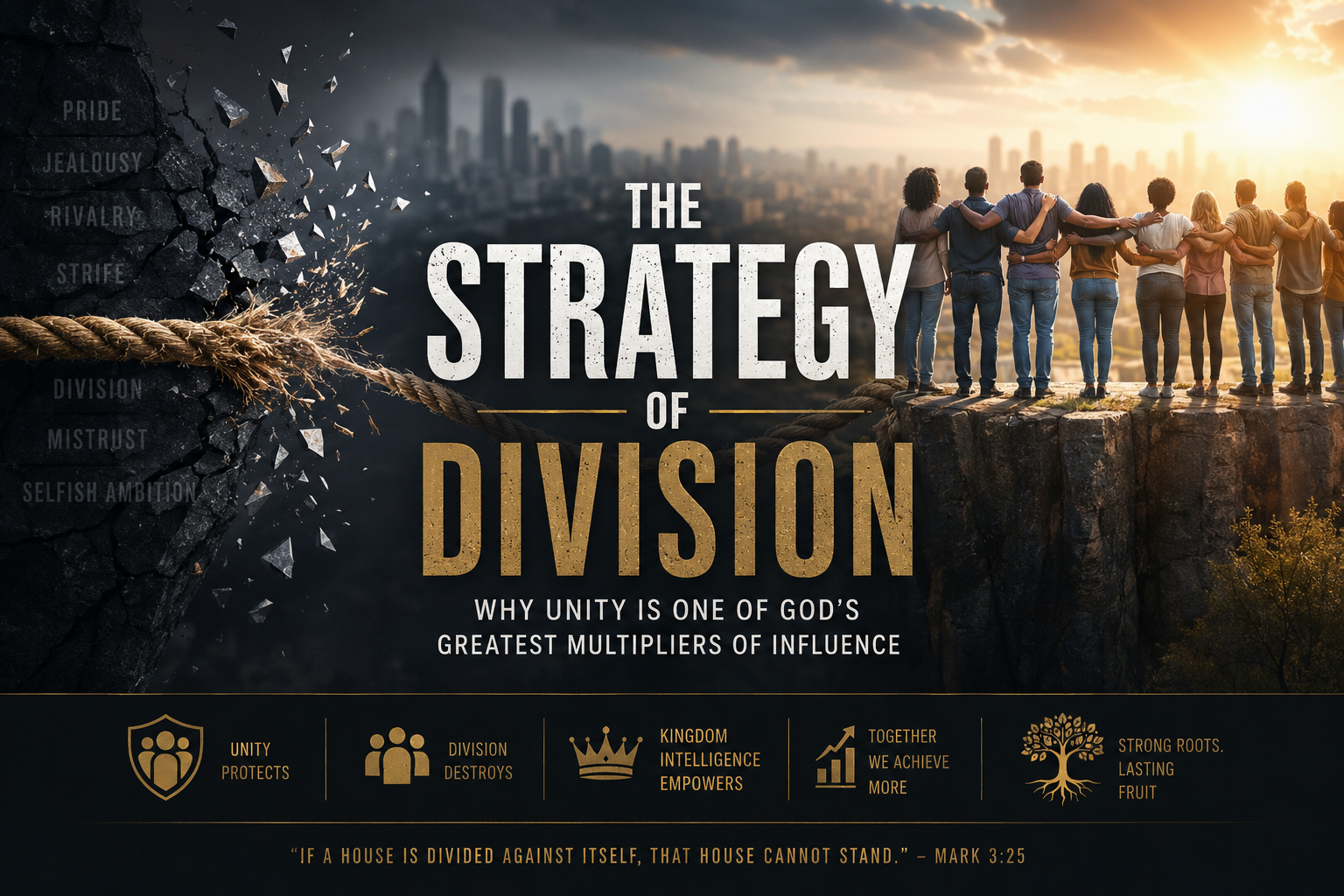
Scripture identified this principle long before modern organisational theory: “If a house is divided against itself, that house cannot stand.” — Mark 3:25
The issue, therefore, is bigger than conflict. It is about unity, trust, shared purpose and collective capacity.
Biblical unity is not merely a spiritual ideal. It is also a powerful principle of collective strength.
At HigherRealmToday, we call this Kingdom Intelligence: recognising that unity is not merely an emotion or a pleasant ideal; it is a strategic asset that multiplies influence, while division silently erodes it from within.
Scripture, history, organisational leadership, and even modern management research consistently point in the same direction.
Internal fragmentation often precedes external defeat.
The First Battle Is Rarely Physical
When Jesus healed a demon-oppressed man in Matthew 12 and Mark 3, the miracle itself was undeniable. Unable to refute what had happened, some of the religious leaders questioned the source of His authority. Jesus answered with one of the most profound leadership principles ever recorded:
“If a kingdom is divided against itself, that kingdom cannot stand. If a house is divided against itself, that house cannot stand.” (Mark 3:24–25)
Notice that Jesus did not merely address demons; rather, He revealed a universal principle: division weakens systems from the inside.
Whether the system is a family, a business, a ministry, or a nation, sustained internal conflict eventually limits its effectiveness.
Kingdom Intelligence: Unity Is Multiplication
One of the defining characteristics of Kingdom Intelligence is the ability to recognise invisible assets.
Most people understand financial capital; fewer appreciate relational capital.
Trust, shared purpose, common values, healthy communication, mutual honour, etc., these are all invisible forms of wealth. In the same way that financial wealth must be understood and stewarded wisely, relational and intellectual resources also determine what individuals and organisations can build. When they disappear, organisations often begin to decline long before financial problems become visible.
Unity is not uniformity.
People may differ in personality, gifting, culture, and perspective while remaining united around a common mission.
That distinction is vital.
Healthy unity welcomes diversity of contribution while preserving clarity of purpose.
Babel: The Surprising Lesson
Genesis 11 contains one of the Bible’s most fascinating leadership case studies.
The people shared one language, one vision, and one coordinated effort.
God observed:
“The people are one… and nothing they plan to do will be impossible for them.” (Genesis 11:6)
Notice what God acknowledged.
Unity multiplies capacity.
The issue at Babel was not teamwork itself; it was the direction of that teamwork. Their unity was being used in rebellion rather than obedience.
God confused their language, and the project collapsed; not because they suddenly lost skill, but because they lost coordinated understanding.
The lesson remains.
Shared purpose amplifies human potential.
Division Is More Than Disagreement
Many people mistake disagreement for division, but they are not the same. Healthy organisations encourage thoughtful disagreement. The ability to distinguish between useful disagreement and destructive division requires something deeper than good intentions: it requires wisdom and accurate understanding.
Division begins when disagreement destroys trust, shared purpose, or mutual commitment.
The Apostle Paul repeatedly urged believers to preserve “the unity of the Spirit in the bond of peace” (Ephesians 4:3), not because Christians would never disagree, but because relationships mattered more than personal preferences.
Kingdom Intelligence teaches us to distinguish between constructive dialogue and destructive division.
The Strategy of Divide and Rule
Throughout history, powerful empires have sometimes governed large populations by encouraging rivalries among competing groups. Historians commonly refer to this broad approach as “divide and rule“ (or “divide and conquer”).
The underlying principle is simple: People who distrust one another rarely cooperate effectively.
This pattern has appeared in different forms across different civilizations and historical periods. It reminds us that fractured communities are often easier to influence than united ones.
The lesson extends beyond politics.
Businesses lose momentum when departments compete instead of collaborate.
Churches weaken when personal ambition replaces shared mission.
Families suffer when unresolved conflict becomes normal.
Division quietly drains collective strength.
Jehoshaphat and the Power of Confusion
Scripture records a remarkable example in 2 Chronicles 20.
Judah faced an overwhelming coalition of enemy nations. Instead of relying first upon military strength, King Jehoshaphat sought God.
The Lord intervened.
The opposing armies turned against one another, and confusion spread throughout their ranks. That, of course, led to their overwhelming defeat
Judah’s victory came not because their enemies grew weaker individually, but because they ceased acting together.
The account reminds us that unity is itself a form of strength.
The Kingdom Unity Framework
HigherRealmToday summarises this principle in what we call the Kingdom Unity Framework.
Shared Truth
A people must agree on foundational convictions.
↓
Shared Vision
Everyone understands where the organisation is going.
↓
Shared Trust
Relationships become stronger than suspicion.
↓
Shared Responsibility
Every person contributes rather than merely consumes.
↓
Shared Victory
Collective effort produces multiplied influence.
When one of these foundations weakens, unity begins to erode.
Protect the Culture Before You Protect the Structure
Many leaders spend enormous energy protecting buildings, budgets, strategies, and systems; few spend equal energy protecting culture. Yet culture determines whether systems flourish.
Healthy cultures cultivate:
- Humility.
- Honest communication.
- Forgiveness.
- Accountability.
- Mutual honour.
- Shared purpose.
These qualities cannot eliminate every conflict, but they can prevent conflict from becoming division.
Unity Requires Intentional Stewardship
Unity does not happen accidentally, nor does trust.
Every healthy marriage, every flourishing church, every effective leadership team, every enduring institution must continually invest in relationships. Left unattended, misunderstanding naturally grows. T
he same principle applies to prosperity: what God places in our hands must be developed, stewarded and multiplied.
Scripture therefore commands believers to be “eager to maintain the unity of the Spirit” (Ephesians 4:3).
Notice the language.
Unity is not merely received; it must be maintained.
Final Thoughts
Every generation must decide what kind of culture it will build: one marked by suspicion, or one marked by trust.
One consumed by rivalry, or one strengthened by shared purpose.
The enemy has always understood that divided people become vulnerable.
The Kingdom teaches something greater: united people become remarkably fruitful.
Whether you lead a family, a ministry, a business, a classroom, or an organisation, never underestimate the strategic value of unity.
Protect it, cultivate it, strengthen it, because unity is more than harmony. It is one of God’s greatest multipliers of influence.
That is Kingdom Intelligence.
Frequently Asked Questions
Does unity mean everyone must think alike?
No. Biblical unity is not uniformity. Scripture presents the Church as one body with many members (1 Corinthians 12). Different gifts and perspectives can strengthen a community when united around a common mission.
How can leaders prevent destructive division?
By communicating clearly, building trust, addressing conflict early, modelling humility, and keeping people focused on shared values rather than personal agendas.
What is Kingdom Intelligence?
Kingdom Intelligence is the disciplined application of biblical truth, wisdom, and practical insight to leadership, stewardship, decision-making, and culture. It helps believers think clearly and build faithfully in every sphere of life.
Why is unity so important in Scripture?
Because unity reflects God’s character, strengthens His people, and enables them to fulfil their mission more effectively. Jesus prayed that His followers would be one (John 17:20–23), and the early Church’s unity became a powerful witness to the world.
Image: AI